

Rooms not to take: Rossio, Appartamento, Corner. Massive noise level being right above the train station all night long.
Best are Duque Lisbon Suite, Lisbon Suite, Panoramic Terrace (slightly more expensive), Duque Garden Suite, Duplex Terrace Suite and Castel Jacuzzi Terrace I, II and III (the most expensive).
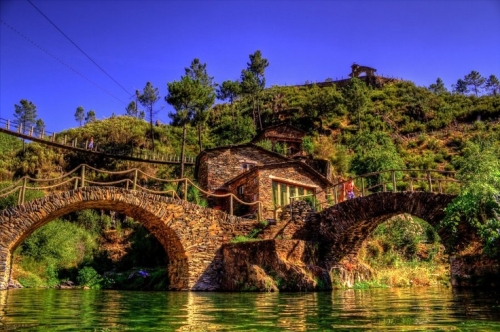
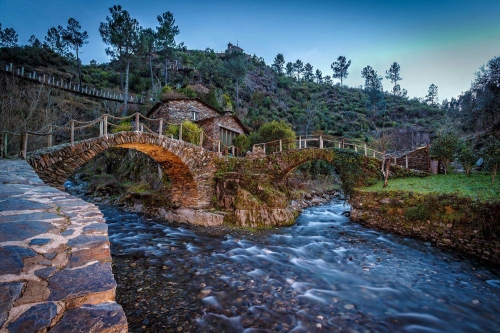
Inland between Porto and Lisbon offbeat track to explore in Portugal on the next visit.
Park your car at Piodao and take a 3 hours walk to Foz d'Egua and back. here a re a 4, 8,9 miles round trips.
Where to Eat Bacalhau Assado Na Brasa com Batata a Murro in Lisbon
After eating this dish a number of times and noting the variations in quality, we found our favorite Lisbon restaurant.
Carvoaria Jacto Restaurant, a local Lisbon restaurant in the non touristy neighborhood of Penha de França offers this dish.
The portions of bacalhau assado brasa com batata a murro dish are massive. Go hungry or plan to share.
What makes this dish exceptional is the use of high quality products. The bacalhau is perfectly grilled.
When drizzled with olive oil and paired with tasty potatoes, you savor the true essence of traditional Portuguese food.
Address: Rua Maria Andrade 6 B, Lisboa
Hours: Open; Monday – Saturday, 12:00 pm to 10:00 pm
Price: €14.50 euros for the Bacalhau and you’ll also find amazing steaks and delicious Portuguese wines
With city-centre rents skyrocketing, this once-bourgeois enclave is fast finding favour with a young, creative crowd. It is only a 20-minute walk from downtown and handy for primary exit routes: Porto’s main bus terminal and train station are on the doorstep and there’s a metro line to the airport.
See and do
There are no malls in Bonfim, but plenty of cool independent stores, mostly on Rua de Santo Ildefonso. Keep an eye out for bookshop Inc. (no 25), a recent outpost of lifestyle outlet Patch (no 95), and the intimate emporium of cheeses and preserves that is Queijaria Amaral (no 190).
Being home to Porto university’s fine arts faculty means Bonfim has always had an active arts scene. For contemporary art, the Senhora Presidenta (Joaquim António de Aguiar 65) and Lehmann + Silva (Duque da Terceira 179) galleries never disappoint. For fans of documentary photography, the recently launched Salut au Monde! (Santos Pousada, 620) is a must.
For superb views over the Douro, stroll around the Parque de Nova Sintra (R. do Barão de Nova Sintra). Once private, this small leafy park is now owned by the water authority and has a wonderful collection of old fountains.
Eat and drink
One of the joys of Bonfim’s relative seclusion from Porto’s tourist boom is the plethora of old-school places to eat. For a classic neighbourhood dinner, try Madureira’s (Rodrigues de Freitas 1) for grilled tiger prawns or a francesinha (doorstep meaty sandwich). Local favourite Casa Aleixo (Estação 216) does a mean octopus with rice. Pulled-pork sandwiches at Casa Guedes (Praça dos Poveiros 130) are another local staple.
Alongside these is a string of exceptional new eateries. Top of the list is Pedro Limão, on Bonfim’s western side, run by an architect-turned-chef serving fine dining at fair prices (10 courses €49); it recently added studio rooms upstairs. If meat-free is your bag, back towards the centre Árvore do Mundo (Duque de Loulé 228) and Manna (R. da Conceição 60) serve splendid vegan/veggie fare (Manna also does yoga classes).
As for cafés and bars, there’s one on nearly every corner. Hip hangouts include speciality coffeehouse Combi (Morgado de Mateus 29) and brunch-lunch-coffee bar Bird of Passage (Duque de Loulé 185). For great cocktails (and pizza), head to TerraPlana (Av. Rodrigues de Freitas 287).
Where to stay
Bonfim’s charm owes much to its elegant, early-20th-century townhouses. None is classier than myhomeinporto (from €200 for 2 nights), a boutique guesthouse run by former interior designer Juan de Mayoralgo. Similarly stylish is the 10-room, French-inspired Cocorico guesthouse (doubles from €90 room-only).
Oliver Balch
Food and Wine Magazine had a very insightful piece on Ferran's younger brother and former chef at El Bulli who rejuvenates Barcelona tapa bars.
El Bulli closed in 2011. “We had to kill the beast,” Albert said. “After so many years, there was a fear of the passion dying.” In the manner of people loosed from long periods of monogamy, they have become men of many ventures. In 2011 they opened Tickets, a madcap bar de tapas in Barcelona’s Eixample Esquerra district. Around the corner is 41°—a high-concept cocktail bar that morphed, once the groupies showed up, into an impossible-to-get-into restaurant, serving elaborate tasting menus that reprise some of the greatest dishes served at El Bulli.
Now, as Ferran burnishes his legacy—building the El Bulli Foundation, a multimillion-dollar center for culinary innovation, and BulliPedia, an online food encyclopedia—Albert is staking his individual reputation on several ambitious projects, all in Barcelona. (Ferran, as ever, is an investor and an ally, but these are Albert’s gigs.) They include Bodega 1900, which will open this summer and feature turn-of-the-century Spanish cooking; a big, rambunctious Mexican place called Yauarcan, which is set to open this fall; and a 32-seat spot called Pakta, where the menu is Nikkei, a hybrid cooking style that Japanese settlers developed in Peru.
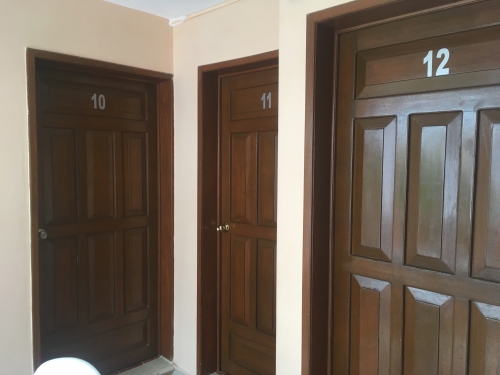
Rooms 5 and 18 are in the front building with windows to the stairwell. Some of the worst. Room 10 is acceptable, has a ceiling fan and a balcony. Room 11 is better as it has views both on the side of the building via balcony and sea. Room 12 has a view on the sea and has 3 beds and on the same floor as 10 and 11.
If you have your heart set on acquiring some vintage furniture pieces from beyond the iron curtain, a trip to Espai Neukölln should be first on your agenda. Alessia and Federico, a pair of Barcelona-based Italians, named their…


First, a fascinating history behind a tile craze in Portugal:
In 1415 the Portuguese captured Ceuta, in what is today Morocco, ending barbarian rule and assuring their control of the Strait of Gibraltar. It was there that they discovered the beauty of Moorish tiles, which were introduced to the area around the 13th century.
The first dated azulejos were believed to have been made in Portugal in 1565. They can still be seen just south of Lisbon at the Quinta da Balcalhoa, which was built in the mid-15th century by King John I as a hunting lodge and transformed into a palace by King Manuel I for his grandmother, the Queen Mother, Infanta Brites. The tiles at the palace are in blue - azul, in Portuguese - which accounts for the name azulejos.
By the 17th century the local artisans had mastered the craft and began to use yellow, purple and green in their purely geometric designs. By 1650 tile panels representing mythological scenes, hunting motifs and landscapes made their appearance and before long azulejos were decorated with garlands, cherubs and blazons.
A tile craze swept the country, creating so great a demand that tiles were even imported from the Netherlands, replacing the local kind in popularity.
In the early 18th century, in an effort to regain Portuguese control of the market, an artisan named Antonio de Oliveira Bernardes and his son, Policarpo, set up a tile school in Lisbon, creating panels in the baroque style, primarily of Old Testament themes. By 1740 tiles began to be made on an industrial scale, resulting in a rapid deterioration in quality. Then, after the Lisbon earthquake of 1755, which destroyed most of the city and many of the factories, quality, hand-made tiles again became popular. They have remained so ever since.
A few addresses from a New York Times article (in pre-euro prices of 1989 and might be different nowadays.)
Solar, 68-70 Rua Dom Pedro V, Lisbon 1100, Portugal; 346-522. Antique tiles ranging from delicate blue-white and yellow designs from the 15th century to Art Deco. Prices, calculated at a rate of 154 escudos to the dollar, range from 65 cents to $19.50 for an ancient tile in good condition.
Berta Marinho designs and makes tiles according to ancient rules and techniques in her Santa Rufino workshop (9A Calcada Conde de Penafiel, Lisbon 1100, Portugal; 876-018), near the Castelo Sao Jorge in the heart of the old city. She specializes in reproductions of 16th-century tiles as well as copies of the work of modern Portuguese painters. Prices are about $9.75 to $13 a tile.
Fabrica Ceramica Viuva Lamego, 25 Largo do Intendente, Lisbon 1100, Portugal; 575-929. Wide selection of copies of 18th- and 19th-century panels, ranging from 60 cents to about $2.50.
Fabrica de Ceramica Constancia, 8 Calcada Santo Domingo a Lapa, Lisbon 1200, Portugal; 600-017. Offers decorative modern tiles, at from 50 cents to $6.50 a tile. The company specializes in reproducing designs from photographs.
Sao Simao Arte, 86 Almirante Reis, Vila Fresca de Azeitao, south of Lisbon; 208-3135. Reproductions of 17th-century tiles, mostly flowers, running from $1.30 to $6.50 a piece.
Isto E Aquilo, Largo de Misericordia, Cascais 2750, Portugal, 20 minutes by car south of Lisbon; 284-0956. Reproductions of 17th- and 18th-century tile panels, fruits and flowers, priced at about $39 for a four-tile panel to $116 for a 30-tile panel.
Ceramica de Bicesse, 35 Quinta da Chajaneira, Bicesse, near Estoril 2765, Portugal; 269-0528. Restores ancient tiles taken from old homes, chapels and other buildings that are being demolished. Priced at $9.75 to $32.50 a tile depending on age and condition. Also makes copies of old tiles for between $5 to $7.75, depending on whether the tiles are cut by machine or hand.
Castel de Palmela, at Palmela, south of Lisbon (no telephone). Antonio Carlos Santos runs a shop in the old guardhouse. On display are hand-painted tiles by his wife, Maria Cecilia Silva. She does reproductions of old tile panels, including a a 24-tile blue, white and yellow panel of a peacock for $78, and signed single- tile flowers priced at $3 a piece.

If you want to see the whole city stretched out along the river bank you need to cross the Tagus to the south bank. Ferries run from Cais do Sodré to Cacilhas four times an hour until 1.20am. A short walk alongside abandoned riverside warehouses brings you to this little restaurant where a few tables and chairs lit by torches are set along the water's edge. There are tables inside (and fishing nets on the ceiling) but the point here is the view: you come here to see the sun setting behind the 25 de Abril suspension bridge and, as darkness falls, the twinkling orange lights of the city.
• Cais do Gingal 69/70, +351 21 275 1380, atirateaorio.pt

El Cañota is a Galicia-inspired seafood tapas bar, and the younger brother of the renowned Rías de Galicia, one of the greatest Galician restaurants in the city and the country. El Cañota serves traditional dishes: fried fish and seafood, patatas bravas, Galician octopus, ensaladilla rusa, draught beer and wine.
Lleida, 7
Poble-sec
Barcelona
08004
Opening hours: Mon closed; Tue-Sat 1pm-4pm, 7.30pm-midnight; Sun 1pm-4pm
Metro: Espanya